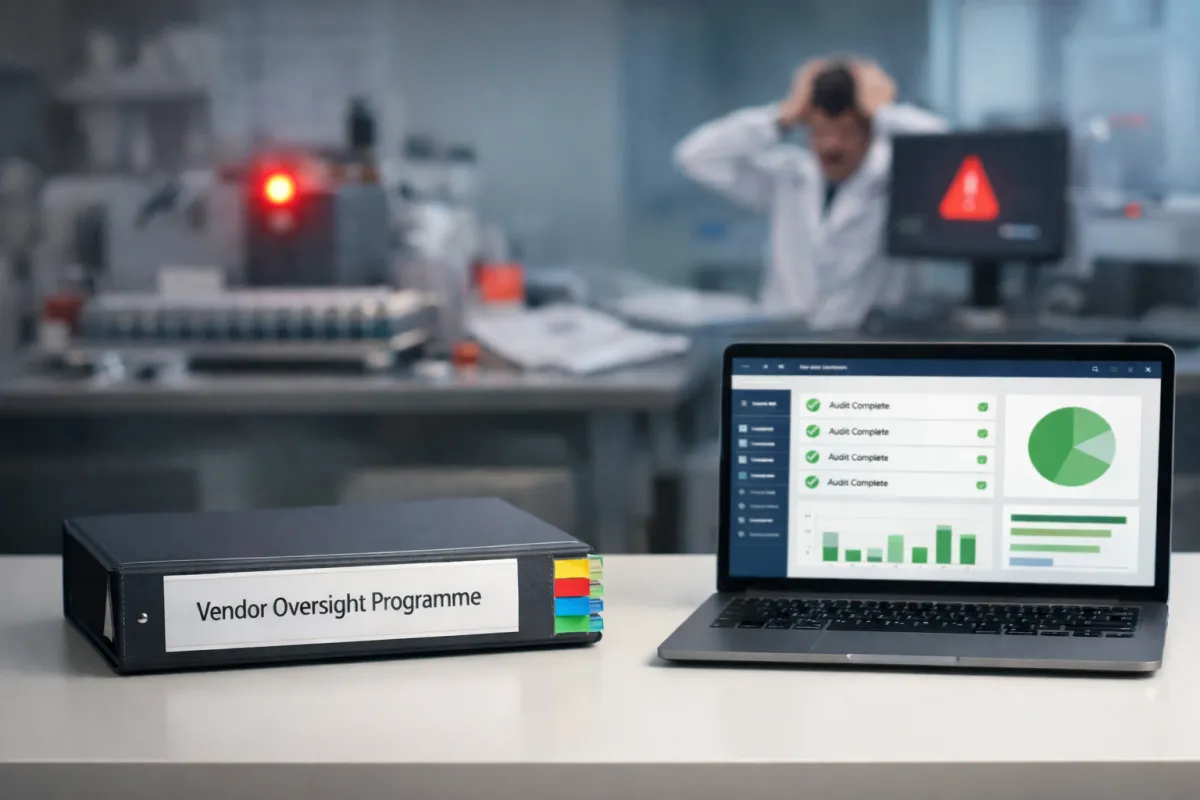
When Vendor Oversight Becomes Admin
And how to spot the drift before an inspector does
Most preclinical organisations would never describe their vendor oversight programme as a paperwork exercise.
And yet, that is exactly how it often behaves.
The drift is usually subtle. It rarely starts with complacency. It starts with pressure: timelines, staff turnover, an audit schedule that keeps slipping, a vendor that is “basically fine”, and a sponsor or internal stakeholder who just wants the box ticked so the study can proceed.
Before long, oversight becomes something you produce rather than something you use.
If this month’s theme is Ready or Reassured?, vendor oversight is one of the easiest places for a false sense of security to take hold.
This article is written to help you diagnose that drift, reset the programme, and understand what is genuinely at stake.
The Drift: From Risk Control to Record Keeping
A healthy oversight programme is built around a simple idea:
Oversight exists to reduce the probability and impact of vendor-related failure.
Paperwork exists to evidence that oversight occurred.
When those two get inverted, you start optimising for evidence rather than effect. That is the drift.
Here are indicators that your vendor oversight is becoming administrative rather than protective.
1) You measure activity, not risk reduction
You can report how many audits were completed, how many questionnaires were returned, how many CAPAs were closed.
But you cannot answer:
Which vendor-related risks matter most for your work?
Whether those risks are trending up or down?
Which controls are actually working?
If your dashboard is full of counts and dates, but empty of risk signals, the programme is telling you you are busy, not safe.
2) Your risk assessment is generic, static, or missing
If vendor risk is assessed once during qualification and then largely forgotten, you are effectively assuming risk is constant.
Risk is not constant. It changes with:
new methods, new species, new equipment, new subcontractors
staffing changes at the vendor
shifts in volume, timelines, or study complexity
changes to critical systems (LIMS, instruments, spreadsheets, archiving)
If you are not revisiting risk at sensible triggers, the programme has become a “front-door check” rather than ongoing oversight.
3) You rely on audit reports as proof of control
Audits are important. They are not ongoing control.
If your programme assumes that an annual audit report equals assurance, you are leaving a large gap between the audit date and what happens day-to-day.
A simple test: if the audit schedule slipped by six months, would you still feel confident?
If the honest answer is “no”, your assurance is time-based rather than risk-based.
4) CAPAs are treated as closure exercises
This one is common. CAPA responses are assessed for completeness and timeliness, not for effectiveness.
Signs you are in administrative CAPA mode:
CAPAs are accepted because they “sound right”
you do not test whether the change actually stuck
repeat observations occur but are explained away as “different contexts”
you rarely ask, “What would we expect to see if this CAPA worked?”
When CAPA becomes correspondence, oversight becomes theatre.
5) QA knows more about vendor performance than operations do
In a resilient organisation, vendor performance intelligence lives close to the work. QA should see the system, not carry it.
If operational teams treat vendor oversight as “a QA thing”, then:
signals are missed
issues are raised late
vendor performance becomes anecdotal
inspection narratives fracture
This is a cultural drift, not a procedural one.
How This Shows Up Under Inspection
Inspectors are often less interested in whether you have a vendor file than whether your oversight programme is alive.
A typical inspection line of questioning does not stop at “show me the audit report”. It moves quickly into:
How did you decide this vendor was suitable for this specific work?
What risks did you identify, and what did you do about them?
How do you know the vendor stayed in control between audits?
How do you ensure subcontractors are controlled?
Show me an example where you escalated a concern and changed your approach.
If your programme is administrative, the answers tend to sound like this:
“We have a procedure…”
“We audit them every year…”
“They sent a CAPA and we approved it…”
“We haven’t had any major issues…”
None of these are evidence of control. They are descriptions of process and absence of known failure.
A more mature programme can show:
risk-based selection and proportionate oversight
trending of deviations, OOS, repeat errors, late reporting, data integrity concerns
management engagement when risk changes
documented decisions that link risk to oversight intensity
learning that altered behaviour (not just closed actions)
Inspection readiness in vendor oversight is rarely about missing documents. It is about weak explanations.
What’s at Stake If You Don’t Reset
The costs of superficial oversight are often hidden until they are suddenly very visible.
Operational cost
repeat work due to protocol deviations, sample integrity issues, method drift, or documentation gaps
delays caused by late discovery of vendor constraints or quality issues
unplanned audits, for-cause visits, or emergency remediation
Compliance and credibility cost
findings that suggest weak sponsor control over outsourced work
questions about data reliability and traceability
loss of confidence from sponsors, internal governance, or partners
Strategic cost
Vendor failures do not stay contained. They compromise programmes, timelines, and investment decisions. In a small or mid-sized organisation, one serious vendor issue can dominate leadership attention for months.
The uncomfortable truth is this:
Admin-heavy oversight is expensive. You pay for it twice.
First in staff time. Then again when it fails to prevent the avoidable.
How to Reset Without Rebuilding Everything
Resetting does not require a new procedure. It requires a new intent.
Step 1: Re-state the purpose in plain language
Put this at the top of your oversight framework:
“Vendor oversight exists to prevent and detect vendor-related failures that could compromise study integrity, timelines, or regulatory acceptability.”
If the programme cannot clearly link to prevention and detection, it will drift back to admin.
Step 2: Define your “critical-to-study” risk triggers
Choose a short list (5–8) of triggers that force re-evaluation of vendor risk and oversight intensity, such as:
new method or platform
high-impact study type
significant deviation trend
subcontracting introduced or changed
key staff turnover at vendor
significant change to critical systems
repeated CAPA themes
significant schedule compression
This is how you move from calendar oversight to risk-triggered oversight.
Step 3: Replace audit frequency thinking with oversight intensity thinking
Instead of “annual audit”, define oversight levels, for example:
Level 1: light-touch monitoring + periodic check-in
Level 2: targeted review of key deliverables + escalation criteria
Level 3: deep oversight: on-site/remote activity, data review, governance cadence
Your goal is not more oversight. It is the right oversight in the right places.
Step 4: Make CAPA effectiveness non-negotiable
Pick one or two simple mechanisms:
defined effectiveness evidence for each CAPA (what you expect to see)
follow-up sampling (document set, raw data spot-check, process observation)
repeat theme triggers escalation
If you cannot verify effectiveness, you are managing correspondence, not risk.
Step 5: Build a living vendor performance view
Keep it simple, but keep it real:
deviation themes
timeliness and responsiveness
recurring documentation gaps
data integrity signals
audit/CAPA themes
outcomes of check-ins and escalations
One page per critical vendor. Updated routinely. Used in decisions.
If it is not used, stop pretending it is oversight.
Action Box
Three things to do in the next month
Pick your top three vendors by study impact (not by spend). For each, write the top three risks that could compromise study integrity. If you cannot do this quickly, your oversight programme is not risk-led.
Review your last two vendor CAPAs. For each, ask: “What evidence do we have that this prevented recurrence?” If the answer is “none”, that is your reset starting point.
Run one ‘inspection-style’ vendor oversight interview with an operational lead: “Why this vendor, what risks, what controls, what changed recently?” If QA has to answer on their behalf, you have a readiness gap.
A closing question
If a study failed tomorrow due to a vendor issue, would your oversight records demonstrate that the failure was genuinely unforeseeable?
Or would they show that you were organised, but not protected?
If you want a second set of eyes on whether your vendor oversight programme is reducing risk or simply producing evidence, that is exactly the sort of conversation Thomas and the team have with clients.